BSc in Electronics is a 3-year full-time undergraduate programme taught on the MIT University Sikkim campus at Namchi, Sikkim, across 6 semesters and 120 credits (Level 6). Electronics is the main subject in every year, supported by practical work, a project or internship and continuous assessment. Eligibility: 12th with Relevant Subject or Math. On completion the award is BSc Degree — 120 Credits.
Built around Electronics, BSc in Electronics is a 3-year on-campus programme covering physical laws, chemical behaviour and quantitative reasoning in 6 planned semesters.
Alongside the Electronics papers you get instrumentation and measurement labs, problem-solving tutorials and statistical and computational exercises. The award on completion is BSc Degree, and the work you produce during the programme becomes your portfolio.
What BSc in Electronics gives you
A single clear subject focus: Electronics, studied properly for 3 years rather than spread thin.
Practical work every semester — instrumentation and measurement labs, problem-solving tutorials and statistical and computational exercises — so you can show what you can do, not only what you studied.
Subject choices that stay relevant: Computer Science, Information Technology and Data Science.
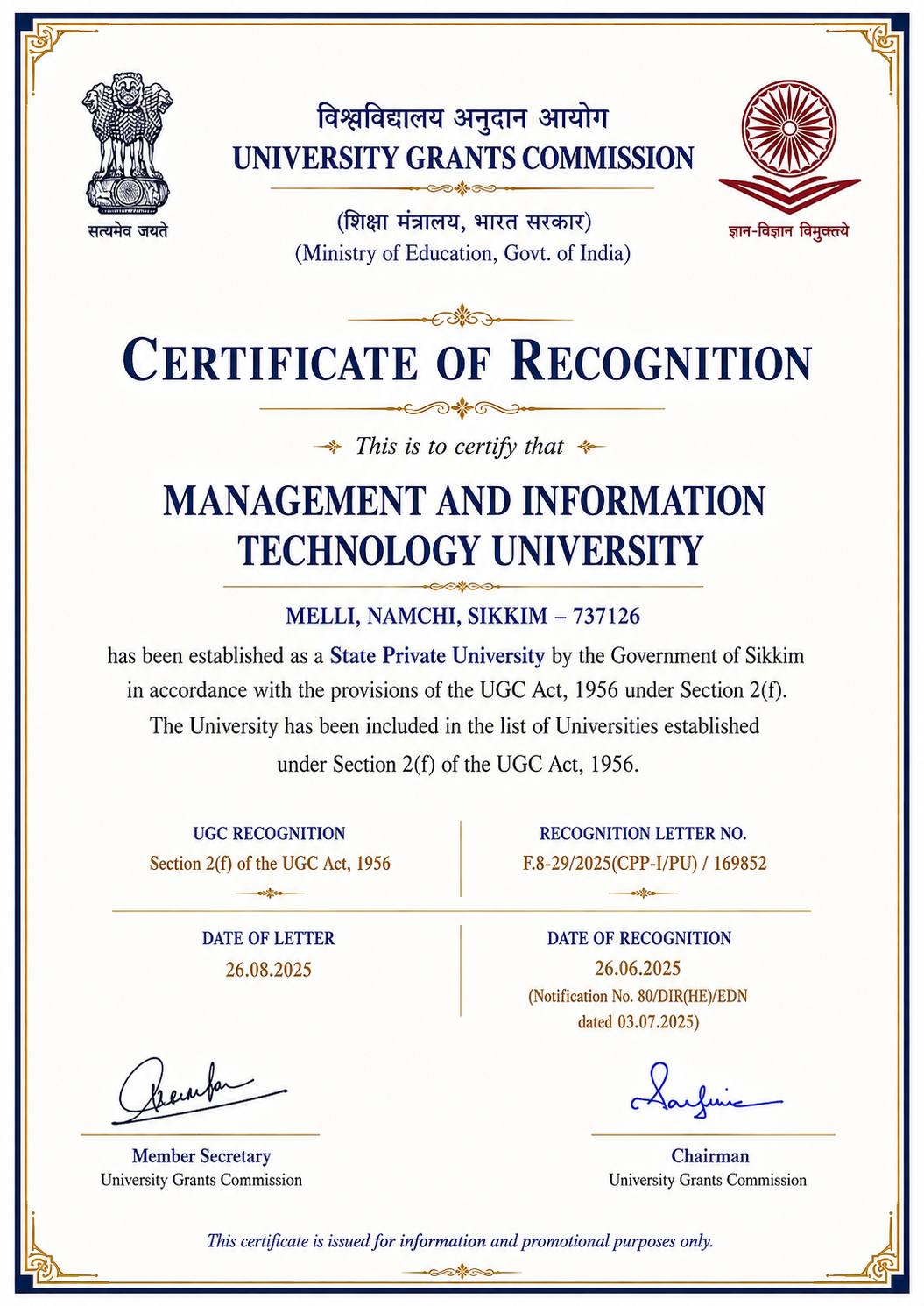
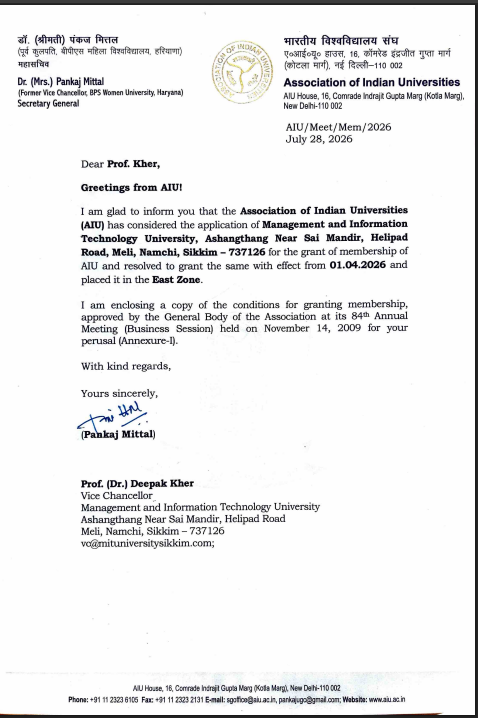
A degree from a UGC-recognised state private university, valid for employment and for further study.
Small campus, direct access to faculty, and daily classroom support at Namchi, Sikkim.
What you will be able to do
Model a problem mathematically and solve it in the context of Electronics.
Run experiments and analyse measurement error in the context of Electronics.
Use statistical and computational tools in the context of Electronics.
Present quantitative findings clearly in the context of Electronics.
Complete a Electronics project or internship and present it to faculty.
Learning environment
A quiet Himalayan campus with residential facilities, sport and student activities — useful for a programme like BSc in Electronics that needs consistent daily study.
Career preparation
Resume writing, communication and interview practice are part of the programme, aimed at the roles BSc in Electronics graduates actually apply for.
UGC-recognised university
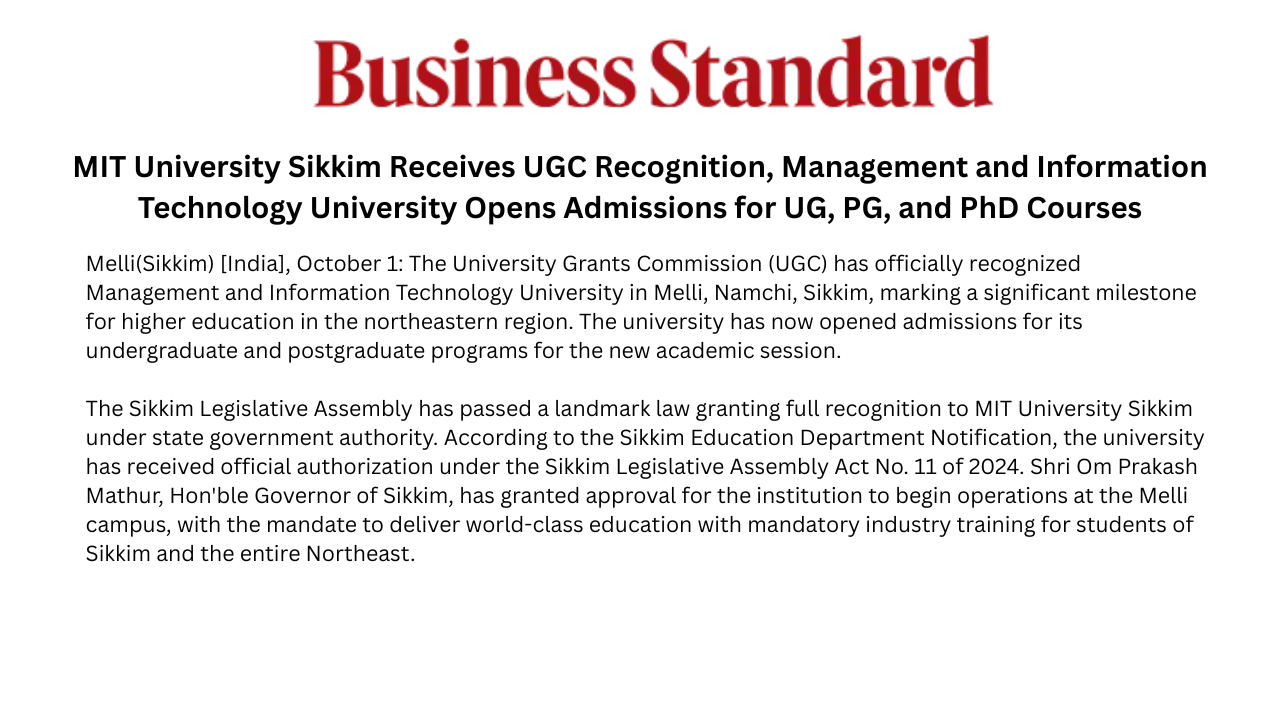
MIT University Sikkim is a state private university established by the Government of Sikkim under Sikkim Act No. 11 of 2024. BSc in Electronics is taught as a regular university programme.
Faculty access
Batch sizes stay small enough that Electronics faculty know each student, review project work individually and are reachable outside class hours.
Course Guide
BSc in Electronics — Complete Course Information
1Programme Structure & Credit System
BSc in Electronics is a 3-year, 120-credit undergraduate programme taught full-time on the Namchi campus across 6 semesters at Level 6, under NEP 2020 and the Choice Based Credit System.
Electronics is the main subject in every year, supported by allied, skill and value-added papers, leading to BSc Degree — 120 Credits.
2Eligibility & Who Should Apply
The minimum qualification is 12th with Relevant Subject or Math. Admission is merit based, with no entrance examination and no upper age limit.
The programme suits students aiming at a career in physical sciences & mathematics, working candidates who need a recognised degree, and anyone planning higher studies or competitive examinations.
3Curriculum & What You Will Learn
The early semesters build the foundation of Electronics alongside language, digital and multidisciplinary courses; the middle semesters move into core theory and applied work in areas such as Computer Science, Information Technology, Data Science and Artificial Intelligence & Machine Learning.
The final year adds advanced coursework, an internship or on-the-job training and a capstone project, with continuous internal assessment and built-in soft-skill, resume and interview training.
4Career Opportunities & Higher Studies
Graduates typically start in roles such as Data Analyst, Research Assistant, Quality Control Officer and Science Educator, in both private organisations and government recruitment where the notification allows.
The degree qualifies you for a two-year postgraduate programme in Electronics or an allied field; the optional 4-year, 160-credit Honours route additionally opens one-year PG programmes and direct PhD entry as per UGC norms.
5Admission Process for 2026
Apply online on the official portal: fill in your personal and academic details, upload documents and pay the ₹10,000 registration fee. Applications for the 2026 session are open now.
The admissions team verifies your documents and confirms eligibility, usually within a couple of working days, after which you complete the fee formalities and receive your enrolment number. Counselling is free — call +91 6009466009 or submit the enquiry form on this page.
6Fees, Scholarships & Required Documents
Fees vary by programme and year of entry; the current structure is shared by the admissions team and the official fee document is available on the downloads page. Eligible students may receive a scholarship or fee benefit, and 25% of seats are reserved for eligible Sikkim-domicile students.
Keep scanned copies ready: Class 10 and 12 marksheets and certificates, transfer or migration certificate where applicable, a government photo ID such as Aadhaar, a passport-size photograph, your signature, and a category or domicile certificate if claiming a reserved seat or scholarship.
Approval & Recognition
Is BSc in Electronics a Valid Degree?
Yes. BSc in Electronics is awarded by MIT University Sikkim. Approval reference: UGC | MOE | Government of Sikkim approved university programme.
UGC | MOE | Sikkim Government approved university programme
MIT University Sikkim is a state private university established by the Government of Sikkim
Regular-mode study follows university assessment rules, assignments, examinations, practicals, projects or viva where applicable
The qualification may be used for jobs, higher education and competitive exams subject to the rules of the recruiting or admitting authority
Students should verify the latest recognition, mode approvals and examination rules from the university before admission.
Limited Seats Available
Ready to Start Your BSc in Electronics Journey?
Take the next step today, our counsellors respond within 30 minutes.
Full-time on-campus study at Namchi, Sikkim with daily classes, practicals, library access, seminars and campus life. Best for students who want the complete university experience.
What a week looks like
Electronics lectures and tutorials, scheduled practical sessions, and continuous internal assessment through the semester. Attendance, examinations and project submission follow the university academic calendar.
Minimum qualification for BSc in Electronics: 12th with Relevant Subject or Math, from a recognised board or university.
The last qualifying examination should be in the Science stream with relevant subjects such as Physics, Chemistry, Biology, Mathematics or an allied subject, wherever applicable to the chosen Major.
Minimum aggregate marks in the qualifying examination as per the University's admission norms; relaxation for reserved categories as per applicable rules.
Admission is merit-based — no entrance examination and no upper age limit.
The award on completion is BSc Degree — 120 Credits, issued by MIT University Sikkim as a UGC-recognised state private university.
Duration
3 Years · 6 Semesters (CBCS / NEP 2020)
Year 1: Foundation of Electronics, Ability Enhancement Course (AEC), Introduction to the Indian Constitution
Year 2: Core Electronics II, Discipline Elective, Skill Enhancement Course (SEC), Value Added Course (VAC)
Year 3: Advanced Electronics, Industry Internship / On-Job Training, Capstone Project
Note: Eligibility may vary from course to course and is subject to change as per the latest MIT University Sikkim admission rules, UGC guidelines and NEP 2020 provisions. Students are advised to verify course-specific eligibility with the University Admission Cell or an authorised Education Counsellor before applying — call +91 6009466009 or submit the enquiry form on this page.
Limited Seats Available
Ready to Start Your BSc in Electronics Journey?
Take the next step today, our counsellors respond within 30 minutes.
Fill the online enquiry / application form for the 2026 session
02
Step 2
Free counselling call — eligibility and specialisation check within 30 minutes
03
Step 3
Upload documents (marksheets, ID proof, photograph) for verification
04
Step 4
Pay the ₹5,000 registration fee to block your seat
05
Step 5
Receive the provisional admission letter and enrolment number
06
Step 6
Pay the first-year fee (full or instalment) to confirm admission
07
Step 7
Classes begin — LMS/ID card, timetable and student support activated
Documents Checklist
Keep scanned copies ready
Document 01
10th marksheet
Document 02
12th marksheet
Document 03
Graduation marksheet (for PG)
Document 04
Transfer / migration certificate
Document 05
ID proof (Aadhaar / Passport)
Document 06
Passport-size photographs
Documents required: 10th & 12th marksheets, graduation marksheet (for PG), transfer/migration certificate, ID proof and passport-size photographs.
Admission 2026
Admission Guidance for BSc in Electronics
Step 01
Who can apply
12th with Relevant Subject or Math, from a recognised board or university. Admission to BSc in Electronics is merit-based — there is no entrance examination and no upper age limit.
Step 02
How to apply
Apply online, fill in your personal and academic details, upload your documents and pay the registration fee. You can complete the whole process from home.
Step 03
Documents to keep ready
Scanned marksheets and certificates of your qualifying examination, a government photo ID, a passport-size photograph and your signature.
Step 04
After you apply
The admissions team verifies your documents, confirms your eligibility for BSc in Electronics and shares the fee structure for your year of entry. Your enrolment number is issued once the fee formalities are complete.
Step 05
Fees and scholarships
The current fee structure for BSc in Electronics is shared by the admissions team on request. Eligible students may receive a scholarship or fee benefit; eligibility is confirmed by the university after your application is reviewed.
Step 06
Need help deciding
Counselling is free. Call +91 6009466009 or submit the enquiry form on this page and a counsellor will explain BSc in Electronics — subjects, timetable, campus and fees — before you apply.
BSc in Electronics is completed as a 3-year, 120-credit degree. Every student follows the same curriculum and graduates with a full UGC-recognised degree.
3-Year Degree — 120 Credits
BSc Degree · 6 Semesters · Level 6
A full UGC-recognised BSc degree in Electronics
6 semesters of regular on-campus study at Namchi
Accepted for private and government recruitment, and for postgraduate admission, as per the rules of each authority
BSc Degree — 120 Credits, awarded by MIT University Sikkim
Consolidated marksheets for all semesters
A project or internship record you can show to employers
Fees are not published on this page. The admissions team shares the current fee structure for your chosen programme on request — call +91 6009466009 or submit an enquiry.
Limited Seats Available
Ready to Start Your BSc in Electronics Journey?
Take the next step today, our counsellors respond within 30 minutes.
These are the subject groups studied in BSc in Electronics. Paper titles follow the MIT University Sikkim scheme for your year of entry.
Core subjects
The compulsory Electronics papers that every student of this programme studies, taught across all 6 semesters.
Foundations of Electronics
Electronics: Core Theory I
Electronics: Core Theory II
Applied Electronics
Electronics Practical / Tutorial
Practical & skill-based learning
Lab, workshop and skill sessions where you practise the work instead of only reading about it.
Scientific Instrumentation
Data Analysis with Python / R
Computational Techniques
Lab Safety
instrumentation and measurement labs
problem-solving tutorials
Specialised subjects
Additional subject options offered with Electronics, chosen at the start of the programme with guidance from the department.
Computer Science
Information Technology
Data Science
Artificial Intelligence & Machine Learning
Cyber Security
Cloud Computing
Industry-oriented & supporting subjects
Subjects that connect Electronics to the workplace — quality and testing laboratories, analytics and data teams and education and coaching — along with your project or internship.
These are the roles BSc in Electronics graduates commonly apply for, and the kind of organisation that hires for them.
Data Analyst
Typically in technical government services
Research Assistant
Typically in quality and testing laboratories
Quality Control Officer
Typically in analytics and data teams
Science Educator
Typically in education and coaching
Technical Associate
Typically in research organisations
Roles listed are indicative of the field. MIT University Sikkim provides career preparation and placement assistance; it does not guarantee employment or a salary figure.
Explore Further
Relevant Subjects, Specializations & Related Courses
Relevant Subjects
Key papers covered within the BSc in Electronics scheme.
Foundation of ElectronicsAbility Enhancement Course (AEC)Introduction to the Indian ConstitutionCore Electronics IIDiscipline ElectiveSkill Enhancement Course (SEC)Value Added Course (VAC)Advanced ElectronicsIndustry Internship / On-Job TrainingCapstone Project
Specializations
Available specialization options listed for this programme.
Industry Relevance & Career Value of BSc in Electronics
Analytical and quantitative skills transfer directly into data, testing, teaching and competitive examination routes, which keeps this qualification versatile.
For BSc in Electronics specifically, the work is concentrated in quality and testing laboratories, analytics and data teams, education and coaching and research organisations. Employers in these areas look for the exact practical skills this programme trains — model a problem mathematically and solve it and run experiments and analyse measurement error — which is why project and internship work is built into the course rather than left optional.
Skills you can show an employer
Model a problem mathematically and solve it in the context of Electronics.
Run experiments and analyse measurement error in the context of Electronics.
Use statistical and computational tools in the context of Electronics.
Present quantitative findings clearly in the context of Electronics.
Where the course can take you next
Postgraduate study in Electronics or an allied subject.
Professional certifications used in quality and testing laboratories and analytics and data teams.
State and central competitive examinations that accept a bachelor's degree.
Limited Seats Available
Ready to Start Your BSc in Electronics Journey?
Take the next step today, our counsellors respond within 30 minutes.
Based on 13 verified student reviews for BSc in Electronics at MIT University Sikkim.
11 rated 5★ · 2 rated 4★
Suman Joshi
Dehradun · Batch 2026 · 8 months ago
Application No: MIT/SKM/2026/55001
Excellent academic experience
Placement and career guidance for BSc in Electronics started early in my final year. Resume workshops, mock interviews and soft-skill sessions made a visible difference in my confidence.
Sourav Das
Kolkata · Batch 2025 · 1 month ago
Application No: MIT/SKM/2025/55978
Worth every rupee
Overall a solid experience with BSc in Electronics. Good teaching, clear communication, honest fee policy and proper documentation. I have already recommended MIT University Sikkim to two of my friends.
Tanvi Shah
Mumbai · Batch 2026 · 5 months ago
Application No: MIT/SKM/2026/56955
Genuine university, transparent process
I am a working professional and BSc in Electronics fits perfectly with my schedule. The flexible mode allowed me to study without leaving my job, and the university never compromised on academic quality.
Rahul Sharma
Delhi · Batch 2025 · 9 months ago
Application No: MIT/SKM/2025/57932
Flexible and well organised
Placement and career guidance for BSc in Electronics started early in my final year. Resume workshops, mock interviews and soft-skill sessions made a visible difference in my confidence.
Kavita Gupta
Kanpur · Batch 2026 · 2 months ago
Application No: MIT/SKM/2026/58909
Highly recommended for working students
Overall a solid experience with BSc in Electronics. Good teaching, clear communication, honest fee policy and proper documentation. I have already recommended MIT University Sikkim to two of my friends.
Sandeep Rai
Gangtok · Batch 2025 · 6 months ago
Application No: MIT/SKM/2025/59886
Practical learning, real projects
I am a working professional and BSc in Electronics fits perfectly with my schedule. The flexible mode allowed me to study without leaving my job, and the university never compromised on academic quality.
Divya Rao
Bengaluru · Batch 2026 · 10 months ago
Application No: MIT/SKM/2026/60863
Best decision of my career
Placement and career guidance for BSc in Electronics started early in my final year. Resume workshops, mock interviews and soft-skill sessions made a visible difference in my confidence.
Abhishek Jha
Muzaffarpur · Batch 2025 · 3 months ago
Application No: MIT/SKM/2025/61840
Placement guidance was a big plus
Overall a solid experience with BSc in Electronics. Good teaching, clear communication, honest fee policy and proper documentation. I have already recommended MIT University Sikkim to two of my friends.
Sneha Reddy
Hyderabad · Batch 2026 · 7 months ago
Application No: MIT/SKM/2026/62817
Curriculum is truly industry-ready
I am a working professional and BSc in Electronics fits perfectly with my schedule. The flexible mode allowed me to study without leaving my job, and the university never compromised on academic quality.
Rajesh Verma
Noida · Batch 2025 · 11 months ago
Application No: MIT/SKM/2025/63794
Smooth admission, no hidden charges
Placement and career guidance for BSc in Electronics started early in my final year. Resume workshops, mock interviews and soft-skill sessions made a visible difference in my confidence.
Meera Pillai
Thrissur · Batch 2026 · 4 months ago
Application No: MIT/SKM/2026/64771
Confident about my future now
Overall a solid experience with BSc in Electronics. Good teaching, clear communication, honest fee policy and proper documentation. I have already recommended MIT University Sikkim to two of my friends.
Imran Khan
Bhopal · Batch 2025 · 8 months ago
Application No: MIT/SKM/2025/65748
Degree is valid and well recognised
I am a working professional and BSc in Electronics fits perfectly with my schedule. The flexible mode allowed me to study without leaving my job, and the university never compromised on academic quality.
Bhavna Solanki
Rajkot · Batch 2026 · 1 month ago
Application No: MIT/SKM/2026/66725
Very supportive counselling team
Placement and career guidance for BSc in Electronics started early in my final year. Resume workshops, mock interviews and soft-skill sessions made a visible difference in my confidence.
What You Will Receive
Sample Documents
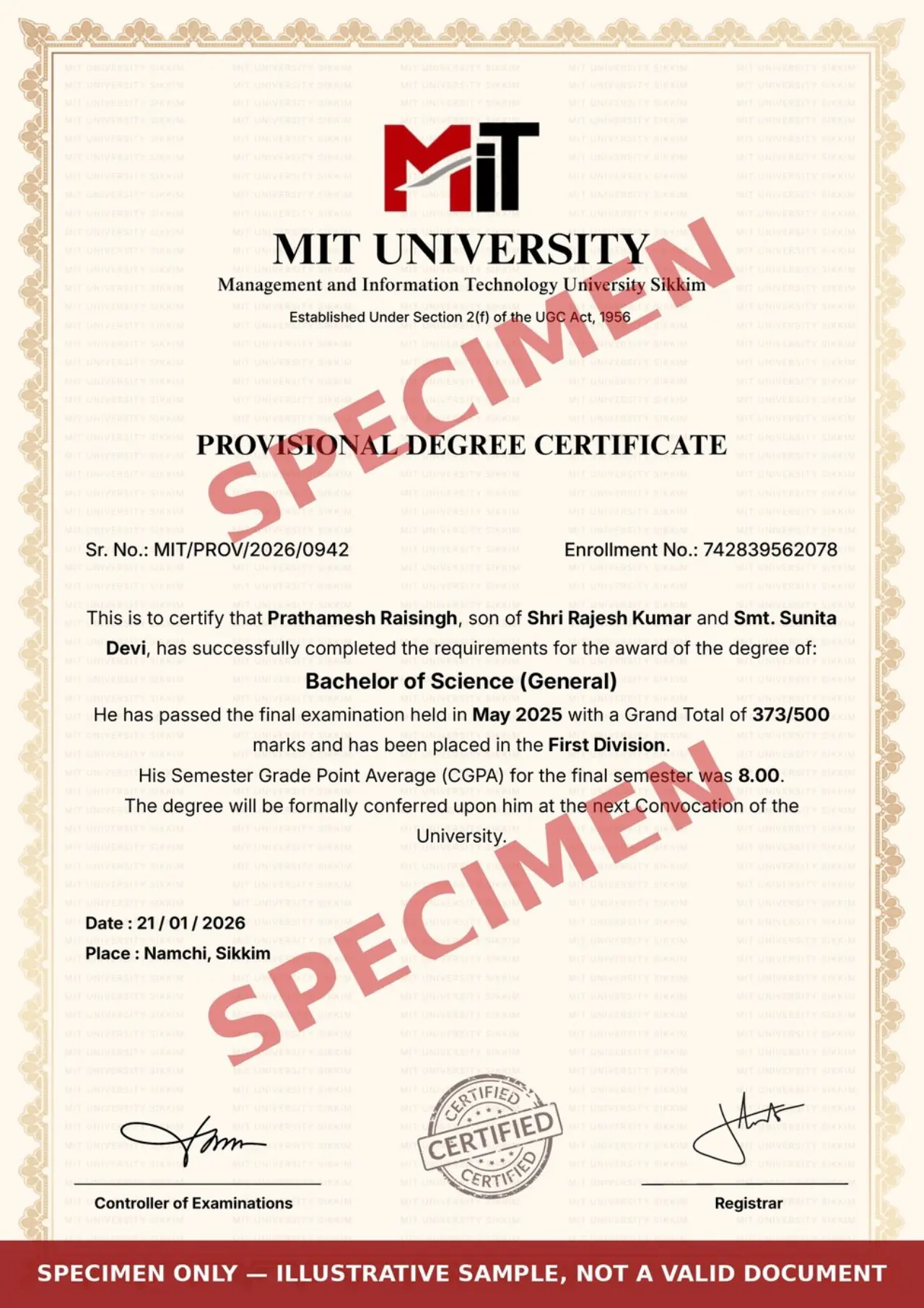
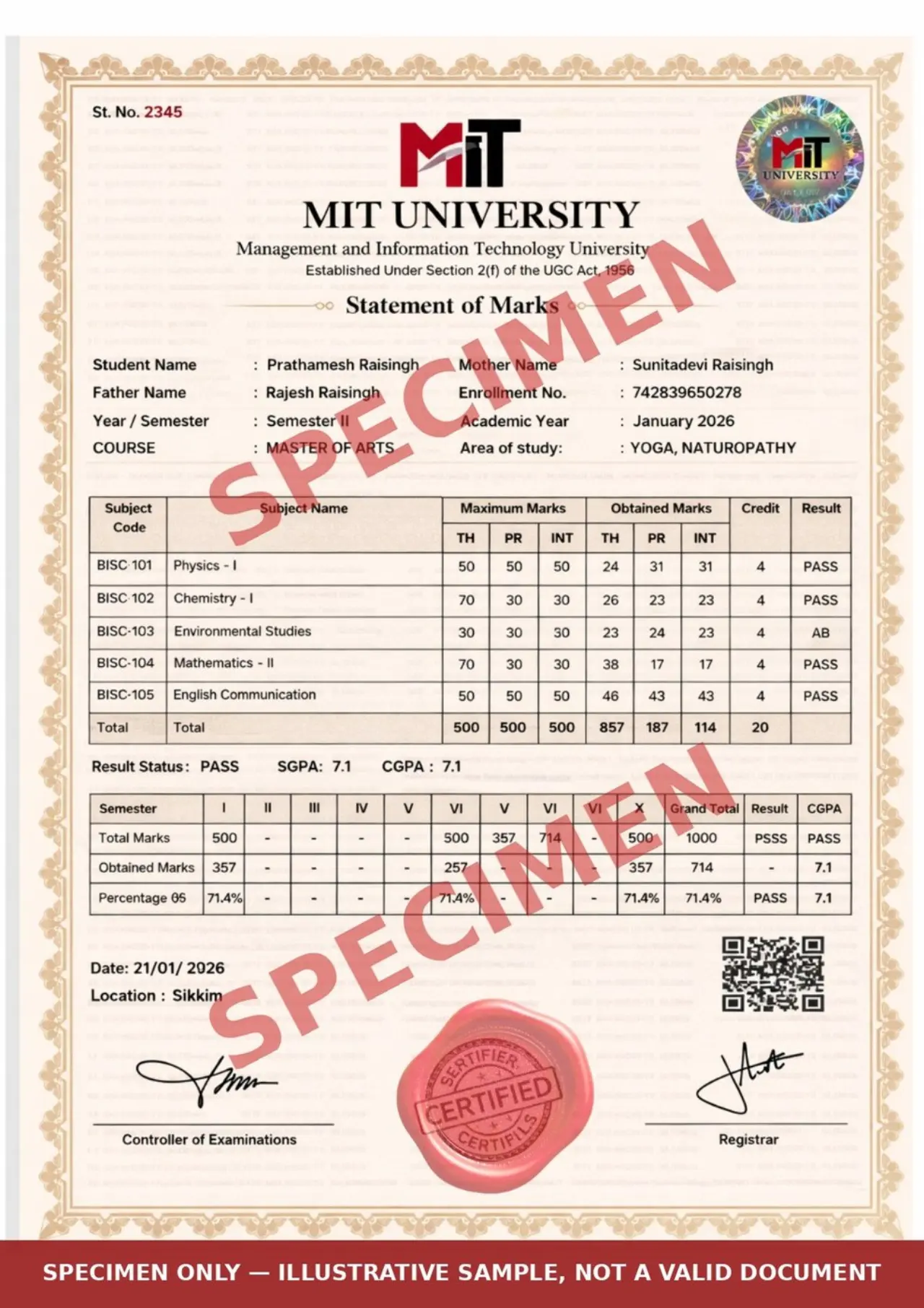
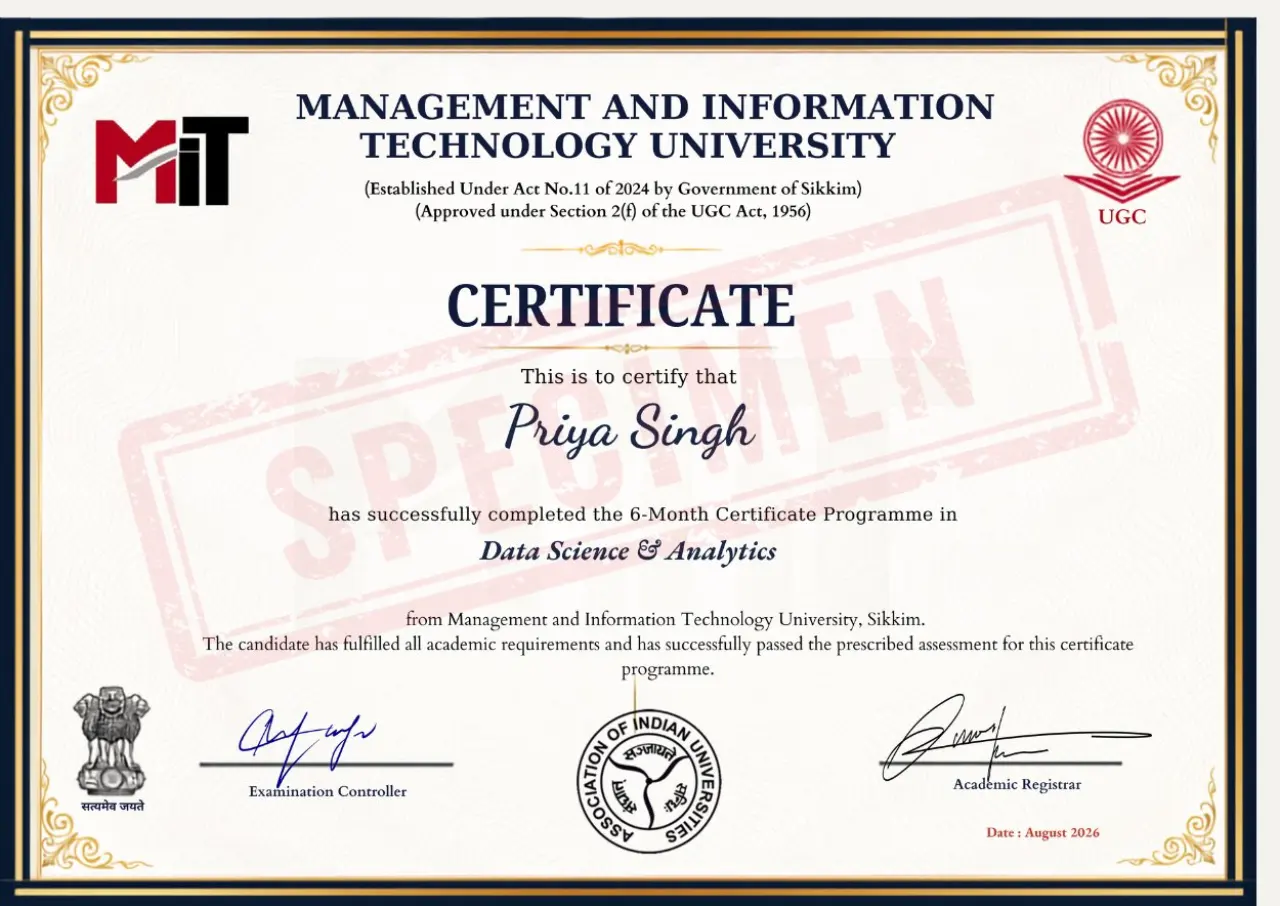
On completing the BSc in Electronics programme at MIT University Sikkim, students receive official, verifiable documents. Specimen samples are shown below — names, marks and dates are fictitious and the images are watermarked; they are invalid for any official use.
Provisional Degree Certificate
Issued after successful completion of the programme, bearing the university seal and signatures.
Statement of Marks
Semester-wise marksheet showing subjects, credits and grades under the CBCS / NEP 2020 framework.
Programme Certificate
Landscape certificate awarded on completion of certificate and diploma programmes.
Specimen only — these samples cannot be used as proof of education. Original documents are issued solely by the university's examination division.